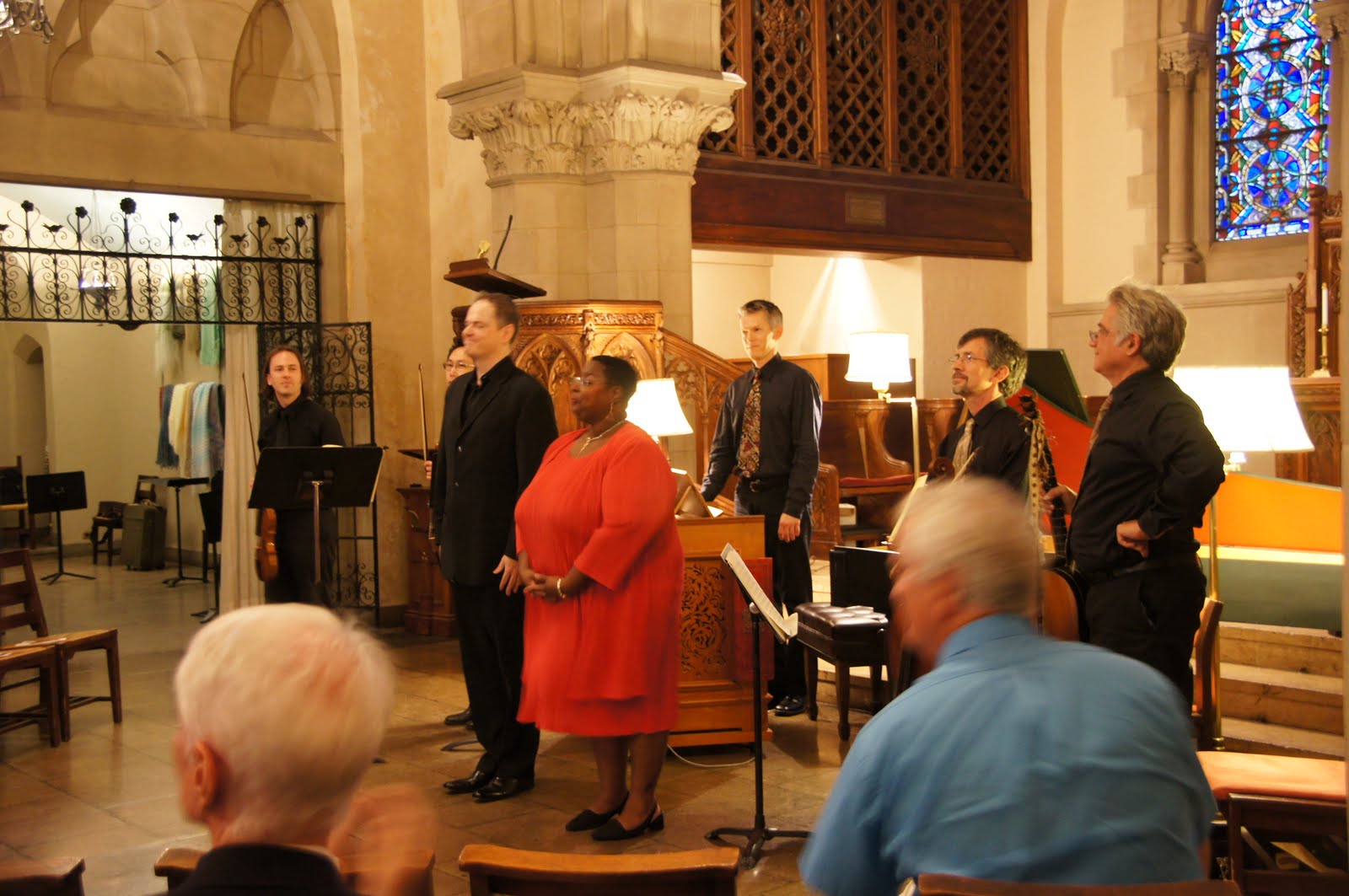
Ars Lyrica performs Handel's "Acis & Galatea" this Thursday in Bryan, Friday in Austin, and Sunday in Houston, TX. Synopsis and notes on the program are as follows:
Handel's Acis & Galatea, known during the composer’s lifetime as “the most perfect work” he had yet written, is the pinnacle of pastoral opera. It is peopled with happy shepherds and nymphs who celebrate the simplicity of rural life...until a monster arrives. Our production transports us to a serene, sultry day in an exotic watery paradise. On a deserted beach, a group of friends discover a chest full of island “treasures,” and slowly, a story unfolds. A beautiful water nymph conceals her divinity in the hope that she may enjoy true love with a mere shepherd. Her great beauty cannot be disguised, however, and it incites a fiery passion in the island monster, Polyphemus, who kills her shepherd lover. Death, of course, is not the end, and Galatea draws on her power to transform Acis into a flowing river whose ever-murmuring waters speak eternally of their love.
The poets John Gay, Alexander Pope, and John Hughes together fashioned the libretto from John Dryden’s translation of the classic story, as related in the thirteenth book of Ovid’s Metamorphoses. Handel’s score begins with a jaunty orchestral sinfonia, which leads directly to a cheerful opening chorus. Despite the jolly atmosphere, Galatea feigns unhappiness. Pleading with the birds to quiet their “thrilling strains,” she observes that their twittering (realized by a sopranino recorder in her first aria) only makes her desire for Acis stronger. Acis, meanwhile, has to be reminded by his companions Damon and Corydon that their first responsibility is to their flocks. Ignoring this sage advice, he becomes totally entranced with Galatea, who in turn offers her own reflections on their love. Both then join together in ecstatic duet, bringing Part I to a close.
Part II opens with a warning that something terrible is about to happen. When the monster Polyphemus enters, all the earth trembles before him. His wooing of Galatea is unsubtle but wonderfully colorful and even ironic in Handel’s clever hands (listen for the same recorder that Galatea sought to quiet in Part I). When Galatea spurns his advances, the monster becomes impatient, vowing to wage war if necessary to win her. Though Damon urges restraint, Acis counters with a shrill call to arms and ignores Corydon’s warning that he is being foolhardy. Galatea attempts to reassure Acis of her fidelity, and they both forswear all others, only to be interrupted repeatedly by Polyphemus, who has decided that Acis must go. And so the hapless shepherd is crushed by the monster’s heavy stone, leaving Galatea and her companions to ponder the fragility of human relationships.
This magical work was first given in 1718 at Cannons, the palatial residence of the Duke of Chandos, for whom Handel worked as court composer for about a year. At its Cannons première, Acis & Galatea was presented as a concert piece (or masque) in front of a painted backdrop, with five costumed singers reading from their books. Handel’s pastoral was not the first musical dramatization of this ancient fable. Charpentier, Lully, Bononcini, and the English composer John Eccles had all tried their hand at it before Handel composed, in 1708, a serenata entitled Aci, Galatea e Polifemo. Owing perhaps to the different language and new circumstances at Cannons, Handel’s 1718 return to this tale produced an entirely new work. In the 1730s and 1740s he made various changes to Acis & Galatea, including additional arias (some in Italian) as well as new orchestrations and rearrangements of movements from the original. Acis & Galatea enjoyed more performances during Handel’s lifetime than any other of his works and remained popular well into the 19th century: it was the first of four works by Handel orchestrated by Mozart in the late 1780s for performances in Vienna at Gottfried van Swieten’s musical salons; Mendelssohn too re-orchestrated and performed it, and Meyerbeer once attempted a staged version. A relatively compact work filled with inspired writing, it remains Handel’s most accessible work for the stage. © Tara Faircloth & Matthew Dirst
Tuesday, March 5, 2013

Wednesday, December 26, 2012
"A Viennese New Year" program and notes
"A Viennese New Year" program and notes:
Christoph Willibald von Gluck Duet: “Va, ma tremo/Ah, mio ben”
(1714-1787) from Ezio, Act I
LAUREN SNOUFFER, SOPRANO
JOHN HOLIDAY, COUNTERTENOR
Johann Heinrich Schmelzer Balletto a 4 — Die Fechtschule
(c1620-1680) (The Musical Sword Fight)
Aria 1
Aria 2
Sarabande
Courante
Fechtschule
Bader Aria
Wolfgang Amadeus Mozart Aria: “Una voce sento al core”
(1756-1791) from La finta giardiniera, Act II
LAUREN SNOUFFER, SOPRANO
Aria: “Dolce d’amor compagna”
from La finta giardiniera, Act II
JOHN HOLIDAY, COUNTERTENOR
Johann Joseph Fux Concerto Le dolcezze e l’amerezze della notte
(1660-1741) Der Nachtwächter
Menuette & Trio
Fantasie notturne
Ronfatore
Aria
W. A. Mozart Recitativo: “In un istante”
Aria: Parto m’affretto”
from Lucio Silla, Act II
LAUREN SNOUFFER, SOPRANO
Aria: “Va pure ad altri in braccio”
from La finta giardiniera, Act III
JOHN HOLIDAY, COUNTERTENOR
Johann Strauss II Pizzicato-Polka
(1825-1899)
W. A. Mozart Duet: “D’Elisio in sen m’attendi/Sposa adorata”
from Lucio Silla, Act I
LAUREN SNOUFFER, SOPRANO
JOHN HOLIDAY, COUNTERTENOR
Since the invention of opera around 1600, leading composers and intellectuals have attempted, once a generation or so, to cleanse their art of the excesses of their predecessors. So it was with Christoph Willibald von Gluck, whose “reform operas” have little of the plot complexities and decorative surface textures of Baroque opera. Instead, Gluck favored a more restrained, naturalistic kind of expression. His 1750 setting of the Metastasian libretto Ezio ennobles a story of revenge and deceit at the highest levels of Roman society. The duet “Va, ma tremo/Ah, mio ben” occurs at the end of Act I, as the general Ezio and his fiancée Fulvia realize that the Emporer’s jealousy may put an end not only to their wedding plans, but to Ezio’s life. The lovers thus pray fervently to the gods to “protect their faithfulness and love.”
A comparable situation causes the two characters of the final duet, from Mozart’s Lucio Silla (Milan, 1772), to express similar sentiments. This story, likewise borrowed from Roman history, includes a pair of lovers who get caught up in the intrigues of a jealous dictator. In this moving duet from the end of Act I, Giunia finds Cecilio, whom she feared dead, and the two express their happiness in tears of joy. Giunia’s great second act scene, part of the second group of arias on tonight’s program, gives a hint of the happy ending to come, though at this point in the drama the heroine is contemplating suicide, thinking she will not be able to rescue Cecilio from the wicked Lucio Silla’s prison.
The remaining three arias on this program are all taken from La finta giardiniera (The Pretend Garden-Girl), an opera Mozart wrote for a Munich theater in 1775. Its plot centers on the relationship between Count Belfiore and the Marchioness Violante, who assumes a disguise as the garden girl Sandrina in order to escape from the violent and abusive count. Sandrina sings “Una voce sento al core” at a particularly delicate moment in the middle of Act II, as she attempts to summon some affection (without success) for her new master, the Podestà, who has just declared himself enamored. “Dolce d’amor compagna,” the flip side of this emotional coin, is sung just a few minutes later by Ramiro, whose love Arminda foolishly rejects; his aria is an ode to unrequited love. Ramiro’s final aria “Va pure ad altri in braccio,” by contrast, is a bit of classic operatic rage, in which he bluntly tells the ungrateful Arminda where she can go.
Around these vocal works are grouped several evocative instrumental selections. Schmelzer depicts a fencing lesson within the parameters of the musical suite, complete with various dances and a “barber’s song” (“Bader Aria”) for the poor fellow whose job it was to bandage up the participants. One wonders whether such a work accompanied some kind of elaborate court ballet with abundant fencing, on the model of Monteverdi’s Combattimento di Tancredi e Clorinda (which Ars Lyrica and the New York Baroque Dance Company presented here last June).
Johann Joseph Fux, a figure known more for his influential Gradus ad Parnassum (The Ascent to Parnassus), a textbook on counterpoint, was court composer to Emporer Leopold I. During his decades of service to the Viennese court, he composed in virtually every genre, including opera, oratorio, and instrumental works of all kinds. His concerto Le dolcezze e l’amerezze della note (The Sweetness and Tenderness of the Night) is really a suite. It begins solemnly, with a cantus-firmus like “call of the watchman,” but continues in a lighter vein, with characteristic dances and unpredictable “nighttime fantasie.”
A Viennese New Year would not be complete without at least a bit of Strauss, and so — on period instruments, no less — the famous “Pizzicato-Polka” of Johann Strauss II. With(out) our Baroque bows. Happy New Year, one and all!
Monday, December 3, 2012
"A Viennese New Year" at Zilkha Hall on Dec 31

The end of the year is fast approaching, and with it the obligatory Christmas shopping, holiday parties, and — most important — big plans for New Year's Eve. On Dec 31 at the Hobby Center, Ars Lyrica offers Houston's classiest New Year's Eve celebration, complete with concert and gala reception to ring in the new year. "A Viennese New Year" features two amazing singers: soprano Lauren Snouffer and countertenor John Holiday plus the Ars Lyrica ensemble in festive music by composers from the Viennese royal court. Our look at elegant old Vienna — where classical music's celebrations of New Year's Eve began — includes arias and duets by Mozart and Gluck, instrumental works by Fux and Schmeltzer, plus one or two New Year's Eve surprises, including a polka by Johann Strauss! The concert begins at 9 pm in the Hobby Center's intimate Zilkha Hall, and the gala follows in the Sarofim Hall Grand Lobby – a perfect place to mingle, sample the buffet, sip champagne, and pick up that last holiday present for either yourself or a loved one at our annual silent auction.
To purchase tickets for the concert and gala reception, visit Ars Lyrica or call the Hobby Center box office at 713-315-2525. Looking forward to celebrating the new year with Mozart, Strauss, and you!
Monday, September 3, 2012

"La Dirindina" is a musical farce, and like all intermezzi, it’s both comic and compact. The story concerns the wily and but gifted young singer Dirindina and her teacher Don Carissimo, whose interest in his pupil is more than a little untoward. As the curtain goes up, a singing lesson is underway, and it is clear that neither student nor teacher are very interested the day’s lesson plan. Dirindina’s independent spirit and her ability to sing (when she wants to) annoy Don Carissimo, who is further vexed by the appearance of Liscione, a famous castrato who brings some surprising news: the Milan theater wants to engage Dirindina as its prima donna. Don Carissimo flies into a rage, stammering his way through a highly amusing and inventive aria, only to see that his pretty pupil is now flirting openly with the castrato. An obligatory ensemble, with Dirindina and Liscione in musical and dramatic opposition to Don Carissimo, brings Part I to a close.
Part II opens with the unctuous Liscione plying Dirindina with a little minuet, which manages simultaneously to flatter the young singer’s ego while sending up the fashionable but sentimental manners of the aristocracy. Dirindina responds with perhaps the oddest aria in the work, full of syncopations and serpentine melodies that cheekily invoke various bodily fluids, with which she promises to seduce the Milanese public. The ensuing “play within a play,” a mock enactment of the tragic Dido’s rejection of the feckless Aeneas, is witnessed by Don Carissimo, who fails to get the joke and thinks that his ward is not only with child but ready to commit suicide. As with all good comedies, the joke’s on him: the finale is both outrageous and touching, as the capon and the hen are joined in hand by a thoroughly confused old man.
The text of "Pur nel sonno" is delivered from the unlucky suitor’s point of view, and from the outset, the mood is dark: an Introduzione in two parts—something one expects at the head of a full-length opera or oratorio, but rarely in a cantata—is by turns aggressive and pensive. The sinewy first aria introduces a world-weary lover, one rejected by the unattainable Phyllis but unable to forget her, even in sleep; his passion remains sadly one-sided. A highly dramatic recitative follows, as the protagonist’s dream veers from lovely visions to fear and shame. The realization that he’ll never be free again is given full vent in a tour-de-force concluding aria with abundant vocal fireworks.
Saturday, July 21, 2012
New harpsichord for St Philip

Just arrived at St Philip Presbyterian Church in Houston, where I play the organ: a new single-manual Flemish-style harpsichord, built for St Philip by John Phillips of Berkeley, CA, after a 1768 instrument by Albert Delin of Tournai. The Delin is an exceptionally versatile historical model, appropriate for a wide range of music in solo and ensemble situations. Its decoration, in particular the painted soundboard with its abundant flora and fauna, is entirely in keeping with the Flemish and French traditions of harpsichord building in the 17th and 18th centuries.
Come hear the inaugural program on the instrument, featuring yours truly and violinist Kurt Johnson on Friday, July 27 at 7:30 pm. St Philip is at 4807 San Felipe, Houston 77056.
Saturday, June 2, 2012
Heaven & Hell

Looking forward to "Heaven and Hell," Ars Lyrica's 2011-12 season finale on June 8 and 10 at the Hobby Center. Here are notes on the program, from myself and Catherine Turocy, Artistic Director of the New York Baroque Dance Company, with whom we're collaborating on an all-Monteverdi program. This is not to be missed: an extraordinary opportunity to witness world première stagings of some of Monteverdi's most exceptional works!
Over the course of an exceptionally long career, Claudio Monteverdi composed some 250 madrigals that range from the comic and satirical to the plangent and war-like. This large and diverse repertory, published in some nine books between 1587 and 1651, is the best witness to the composer’s idiosyncratic and constantly evolving ideas about musical composition. Unusually for their time, these madrigals served as neither domestic music nor polyphonic showpieces but instead as highly expressive, supple works in the modern (mixed) style for professional singers. Because an intense focus on the words is this repertory’s hallmark, line-by-line translations will be given as surtitles throughout the performance.
From the Madrigals of Love and War (1638) our program includes four works, two from each half of this singular collection. Love and war are never very far apart in this poetry, thus most of these “madrigals” freely mix the stile concitato, in which instruments and singers simulate the sound of war by repeated hammering of the same notes (which Monteverdi invented), with sections in either the “languid” or the “temperate” styles. As the composer himself explained: “When [the poetry] speaks about war, it must imitate war; when it speaks about peace, imitate peace; about death, death, and so on.” Both halves of the program begin with settings of sonnets, one by Marini the other by Petrarch, and end with dramatized performances two more expansive tales: the Combattimento di Tancredi e Clorinda and the Ballo delle Ingrate.
The classic Italian sonnet typically comprises fourteen lines, arranged as pair of four-line strophes and another pair of three-line strophes. In Altri canti di marte and Hor ch’el ciel e la terra, Monteverdi underlines the shift from the first to the second half of each poem by setting them as independent sections. The former begins by juxtaposing Mars (the god of war) and Love, whose struggle is the subject of the first half of this evening’s program. Love, as the second part of Marini’s sonnet reminds us, may “give death to the heart,” but it also “gives life to my song.” By contrast Hor ch’el ciel begins with a whisper, since “heaven, earth, and wind are silent,” only to burst to life as the poet “wakes, thinks, burns, and weeps” with the memory of the beloved. Memory, as it turns out, is the enemy of more than just Petrarch’s muse: it is the eternal companion of the unhappy souls in hell who are the subject of the Ballo delle Ingrate.
First performed during the Venetian Carnival season of 1624 in the presence of the “best and noblest inhabitants of the town,” who “wept and were enraptured at this new style” (or so Monteverdi tells us), the Combattimento is based a portion of Torquato Tasso’s epic poem Gerusalemme liberate (Jerusalem Delivered). Set against the backdrop of the First Crusade, a forbidden love has grown between Tancredi, a Christian knight, and Clorinda, a Muslim maiden-warrior. Disguised as a man, she finds herself cut off from her fellow Saracens, and encounters Tancredi when both are battle-weary. They fight vigorously, disregarding all rules of combat: “rage causes every knightly art to be forgotten,” according to Tasso. It is not clear whether Clorinda has recognized Tancredi, but after two bloody encounters, she begs her opponent to baptize her so that she may die a Christian. As he pulls off her hood, Tancredi recognizes her as his lover and weeps as she dies.
Monteverdi’s audience would have been familiar with the story of Tancredi and Clorinda and would have known of the complex and deep love between the fated couple, who (like Romeo and Juliet) came from warring families. Through its detailed evocation of passion and conflict, this musical “combat” tells a universal story, one magnified by the gestures, attitudes and breath of dancers. The score consists mostly of simple narration; direct speech between the two protagonists is brief. Monteverdi instructs the narrator to pronounce the text clearly and directs that the work should be performed with the actors depicting the story in steps and gestures, with strict observance of tempo, beat, and step in a kind of pantomime. His description of the combat, graphically illustrated in the music, is matched by the actions of dancers who are the doubles of the singing Tancredi and Clorinda in this production. In perhaps the most striking departure from the typical emphasis on vocal text painting in the madrigal genre, most of the pictorial effects in this work come from the instrumental accompaniment.
Il Ballo delle Ingrate (The Ballet of the Ungrateful Ladies), set to a libretto by Ottavio Rinuccini, was first performed in Mantua in 1608 as part of the wedding celebrations for Francesco Gonzaga (the son of Monteverdi’s patron Duke Vincenzo) and Margaret of Savoy. Both Vincenzo and Francesco Gonzaga as well as other members of the court took part in the dancing—an odd fact, given that the dance roles seem to be for only women. According to the score, the stage set consists of a Hell’s Mouth (the entrance to the Underworld). Venus and Cupid visit Pluto, King of the Underworld, and complain that Cupid’s arrows are no longer effective on the proud ladies of Mantua, who are scorning their lovers. Cupid asks Pluto to bring the spirits of the ungrateful women who rejected love up from the Underworld to show what fate awaits those who spurn love and marriage. Pluto agrees and the spirits emerge.
The inspiration for the choreography came from Federico Follino, a Mantuan courtier, who gives an eyewitness account of the première. His description of the costumes—“like ashes mixed with flashing sparks; and thus one saw the dresses, and likewise the cloaks (which hung from their shoulders in a very bizarre manner), embroidered with many flames made of silk and gold, so well arranged that everyone judged that they were burning”—combined with his description of the movement suggest a theatrical interpretation after the manner of the morality play. Follino writes that “they did a ballo so beautiful and delightful, with steps, movements and actions now of grief and now of desperation, and now with gestures of pity and now of scorn, sometimes embracing each other as if they had tears of tenderness in their eyes, now striking each other swollen with rage and fury. They were seen from time to time to abhor each other’s sight and to flee each other in frightened manners, and then to follow each other with threatening looks, coming to blows with each other, asking pardon and a thousand other movements, represented with such affect and with such naturalness that the hearts of the onlookers were left so impressed that there was no one in the theater who did not feel his heart move and be disturbed in a thousand ways at the changing of their passions.” (With thanks to Sarah Edgar, dancer/researcher with the NYBDC, who brought this eyewitness account to our attention.) This production, then, acknowledges that Monteverdi and his team were on the cutting edge of a new form of theater based on ancient Greek drama: the Ballo was created one year after L’Orfeo, favola in musica, his first opera.
¬— Matthew Dirst and Catherine Turocy
Tuesday, April 3, 2012
Festival de Musica Barroca in San Miguel

 A number of Ars Lyrica regulars -- including yours truly -- made the trek to beautiful San Miguel de Allende (pictured here) for the annual Festival de Musica Barroca in March. This festival, whose artistic director is our own Barry Sills for the Camerata Ventapane, included two programs with a number of Houston-based musicians, including the Houston Bach Choir. We repeated one of these programs at the Biblioteca Lerdo de Tejada in Mexico City (also pictured here), and did a command performance in Léon for the pope -- who took too much sun that morning and chose to rest instead! Nevermind, the program was much appreciated by a capacity crowd of Catholic prelates and government officials, and we're already planning several performances of Handel's "Acis and Galatea" for next year, in Houston and in Mexico. If you've never been to San Miguel, you should plan on joining us next year for one of the best-kept secrets in the Baroque music world: it's gorgeous, peaceful, and the music-making well worth the trip!
Thursday, March 1, 2012
La Resurrezione Program Notes
Ars Lyrica performs Handel's "La Resurrezione" on March 9 (in Houston) and 10 (in Austin). This rarely-heard work, which dates from the composer’s youthful sojourn to Italy, narrates Jesus’ resurrection as witnessed by Mary Magdalene, her companion Mary Cleophas, St John the Apostle, an Angel, and Lucifer himself. Handel’s telling of this tale, which is organized around eight distinct scenes in two large parts, is full of soaring melodies and striking orchestral colors.
Here is a bit of background, from my program notes:
Handel composed La Resurrezione di nostro Signor Gesù Cristo for the Marquis Francesco Maria Ruspoli, at whose home the work was first performed in concert in 1708, on Easter evening. Ruspoli, an important patron of the arts and prince of the church, was Handel’s principal employer during the young composer’s residency in the Eternal City. In addition to La Resurrezione, Ruspoli had also commissioned for the same season a passion setting by Alessandro Scarlatti. With multiple performances of both works at the Bonelli Palace in Rome during Holy Week of 1708, one wonders how the good Marquis and his friends found any time to attend services!
Thanks to carefully kept payment records, much is known about the première of La Resurrezione. Though not fully staged, Handel’s oratorio was given in front of painted backdrops that depicted each scene. With the composer in charge, the virtuoso violinist Arcangelo Corelli served as concertmaster for an unusually large orchestra that included a few exotic instruments: the viola da gamba, for example, is featured prominently in several movements. The cast included five of Italy’s finest singers, including Marguerita Durastanti, who created a stir as Mary Magdalene since at that time women were forbidden by papal order from singing in public in Rome; she seems to have been replaced by a castrato in subsequent performances. The roles of the Angel and Mary Cleophas were likewise sung by castrati whose ranges are good match for a modern lyric soprano and alto countertenor, respectively. Some 1500 libretti were printed for at least three performances of the work, something of a record for a new oratorio in Rome at the turn of the century.
One reason why oratorios were so popular in early eighteenth-century Rome is because the genre was effectively opera in disguise: oratorio fulfilled the taste for large-scale dramatic musical works while obeying (at least to the letter of the law) the papacy’s periodic decrees against theatrical entertainments of all sorts, including operas. Performances were given in the grandest Roman houses and palaces, which often had private theaters or rooms large enough to accommodate several hundred spectators. These rooms were often lavishly decorated for oratorio performances and the singers costumed in elaborate operatic garb.
More operatic in nature than Handel’s earlier allegorical oratorio Il trinfo del Tempo, La Resurrezione was a great success from the start. Its characters, from the swaggering Lucifer to the grief-stricken Mary Magdalene, are dramatically conceived and each sings arias in the latest operatic fashion. (Handel in fact re-used several of Resurrezione arias in later operas and oratorios, in one case not changing a single word of text!) The lack of any real choral writing also separates this work from Handel’s later English-language oratorios, in which the chorus is often the most prominent voice. The two choral numbers in La Resurrezione are intended for all the soloists, in the fashion of the “coro” that typically provides closure for Italian Baroque operas.
Tuesday, December 20, 2011
Bach and Time – New Year's Eve 2011

Should auld acquaintance be forgot,
and never brought to mind?
Should auld acquaintance be forgot,
and auld lang syne?
For auld lang syne, my dear,
for auld lang syne,
we’ll take a cup o’kindness yet,
for auld lang syne.
And surely you’ll buy your pint cup,
and surely I’ll buy mine!
And we’ll take a cup o’kindness yet,
for auld lang syne.
Every New Year’s Eve at midnight, millions of revelers the world over stumble through these famous words by the Scottish bard Robert Burns. Last week in New York, I encountered them under glass (literally, thanks to Pierpont Morgan’s eccentric collecting habits) and marveled again at their universality: they seemed somehow less corny in the original manuscript and earliest prints. Remembering “old times” — more precisely, the unique character of past events, things, and people — is crucial. Without memory, there is no culture.
On New Year's Eve 2011, Ars Lyrica Houston will savor a few of the greatest moments in our collective musical past, with major works by J. S. Bach on the subject of time. Then we party! Please note that our 2011 New Year’s Eve Gala is upstairs in the Grand Lobby of Sarofim Hall, not the Founder’s Club as in previous years. Good luck to all at the silent auction — may everyone win at least a “pint cup,” as Burns’ lyrics suggest!
Bach and Time program:
"Gottes Zeit ist die allerbeste Zeit," BWV 106
Suite in D Major, BWV 1068
"Ehre sei dir, Gott, gesungen" (Christmas Oratorio Pt. V), BWV 248/5
Program notes for Bach and Time:
Like most of us, Johann Sebastian Bach understood time to operate in multiple dimensions. His weekly responsibilities as the cantor and chief composer for Leipzig’s principal churches surely made him efficient with his own day-to-day time, since such a position required a new cantata every week. On a more spiritual level, Bach’s orthodox Lutheran milieu also conceived of time within a specifically Christian framework, encompassing everything from creation to eternity. God’s time (to use the locution of BWV 106: “Gottes Zeit”) is eternal, whereas human time is demarcated by salvation history, whose broad outlines are the giving of the Law, the revelation of the Gospels, and the obligation to live a moral life in the here and now.
Bach and his anonymous librettist juxtaposed all these ideas about time to great effect in Gottes Zeit ist die allerbeste Zeit (“God’s is the best time”). An intimation of eternity seems present from the opening notes of the Sonatina, whose archaic scoring for two recorders and two violas da gamba must have struck even its first hearers as an oddly quaint way to set such expressive and modern musical figures. Four singers then take center stage, for a cantata whose various sections announce that God’s time is eternal, that ours is brief, and that belief eventually leads us to a better place.
Unlike later cantatas organized around freestanding recitatives and arias, Cantata 106 looks backwards towards 17th-century models in its seamless shuttling from one kind of musical figure and scoring to another for each sentence or section of text. Given its old-fashioned form and its text, scholars have long assumed that Bach wrote this work for a funeral, most likely in 1707, at the very beginning of his career as a composer of church pieces. Its subtitle, “Actus Tragicus,” suggests a potentially broader purpose as well, in keeping with the German tradition of Trauerspiel or morality plays. Here, the tragedy is that of the human condition, which is overcome only in death through faith.
Bach’s Christmas Oratorio is actually a series of six separate cantatas for the Christmas – New Year season, each of which borrows considerable material from older compositions. Cobbled together in 1734, according to the autograph manuscript, this “oratorio” relies on the same alternation of text types and musical textures as do Bach’s passion settings, with Gospel narration by a tenor Evangelist, reflective arias for solo voices, and big “choral” movements leavened regularly by simple four-part chorales.
Part V (Ehre sei dir, Gott, gesungen), intended for the first Sunday after the New Year, begins in an irresistibly cheerful mood, with two oboes d’amore, strings, and voices tossing around the most joyous of musical ideas. The rest of this cantata focuses on the multifaceted role of the Star in the Christmas story: as signal to the Wise Men, as a light to the Gentiles, as a sign of danger for Herod, and as a beacon that continues to shine.
Perhaps the most timeless feature of this program is the beloved “Air” from Bach’s third “orchestral” Suite. Though the larger work otherwise follows a familiar French sequence of movements, complete with an initial “Ouverture” and some very fashionable dances, its best-known part is a humble little tune that Bach slips in just after an imposing opening movement—an unexpected little gift, perfect for this time of year!
© Matthew Dirst
Wednesday, September 14, 2011
Paradise Found program notes
To whet your appetite for "Paradise Found" -- Sept 22 in Bryan, Sept 23 in Houston, and Sept 26 in Alexandria, LA -- here are my notes on this program. Looking forward to seeing many of you at this special set of concerts, featuring the amazing French-Italian soprano Céline Ricci.
"Paradise Found" takes us on a journey comparable to that of Milton's masterpiece, from a Scarlatti cantata’s despairing tones to the heavenly rapture of Handel’s Gloria. In between these vocal “bookends,” instrumental works from the same era illustrate how some of the finest Baroque composers shuttled seamlessly between these emotional extremes, in music that is at once affecting and transformative.
Like his father Alessandro Scarlatti and his contemporaries Handel and Vivaldi, Domenico Scarlatti composed dozens of Italian cantatas for the delectation of aristocratic and royal patrons. Though the genre’s heyday had passed, this master of the newfangled keyboard sonata retained a keen interest in the cantata across a long and productive career. The attraction appears to have been both practical and aesthetic: a genre eminently suited to the intimate cultural pleasures of the Portuguese and Spanish courts (which Scarlatti served from 1719 to the end of his life), the cantata also offered the opportunity for formal experimentation and great subtlety in expression.
Metastasio’s libretto for Pur nel sonno suggests a date of composition sometime during Scarlatti’s tenure at the court of Philip V and Maria Barbara in Madrid. This great poet, the leading opera librettist of the 18th century, had begun his literary career in Rome’s Arcadian Academy, from whose pastoral verse he borrowed stock characters for this cantata. Its “story” is delivered from the unlucky suitor’s point of view, and from the outset, the mood is dark: an Introduzione in two parts—something one might expect only at the head of a full-length opera or oratorio—is by turns aggressive and pensive. The sinewy first aria introduces a world-weary lover, one rejected by the unattainable Phyllis but unable to forget her, even in sleep; his passion remains sadly one-sided. A highly dramatic recitative follows, as the protagonist’s dream veers from lovely visions to fear and shame. His final realization—that he’ll never be free again—is given full vent in a tour-de-force concluding aria with abundant vocal fireworks.
Rameau’s harpsichord music comprises both original works and transcriptions of orchestral dances and character pieces from his popular stage works. The Air pour les Bostangis and the Gavotte are both examples of the latter type. Excerpts from Rameau’s opera-ballet Les Indes Galantes (1735), the first of these charming pieces accompanies a dance by gardeners of the seraglio (the “bostangis”), whose proprieter (the “Gracious Turk” of Act I) is but one of Rameau’s colorful “Indians.” Les Tendres Plaintes and La Joyeuse, by contrast, are more idiomatically conceived for the harpsichord. These two gems encapsulate, within the gently recursive French rondeau form, the two emotional poles of this evening’s program: from “tender complaints” to joy.
Couperin’s La Sultane would also seem, by virtue of its title, to transport us to the Orient; but this is a decidedly Parisian sultan, not an exotic harem-keeper. One of several works Couperin wrote as a kind of French response to the wildly popular Italian trio sonata, La Sultane features unusually full scoring—for two violins, two violas da gamba, and continuo—and a classic sequence of sections in contrasting tempi. Its grandiose and powerful beginning leads to a faster fugue, whose primary theme is nearly identical to that of the opening movement. A tender air and sections in contrasting quicker meters lighten the mood considerably toward the end, as all four instruments engage in concerto-like figuration.
The setting of the Gloria now attributed to Handel came to the world’s attention in 2001. Newspapers heralded its discovery as a major event, despite lingering doubts about its authenticity. If Handel wrote it, he surely did so between 1706 and 1708 in Rome, where such a blatantly theatrical solo setting of this liturgical text would have been well received by patrons who loved opera but were frequently denied it because of recurring papal prohibitions. Its seven discrete movements follow the typical divisions of the “Gloria in excelsis” portion of the mass ordinary. Handel’s virtuosic treatment of the solo voice in the joyous outer movements is noteworthy, as is the highly expressive “Qui tollis,” which makes vivid with tortuous chromatic melodies the “sins of the world.” Because the Gloria lacks a free-standing overture, we have simply borrowed one in the same key from the same composer: the three-movement sequence that introduces Esther (1718), Handel’s first English-language oratorio. ©Matthew Dirst
Thursday, July 7, 2011
Summer Festivals
The biennial Boston Early Music Festival is always a wonderful opportunity to hear some great music, browse through exhibits, and socialize with friends and colleagues from around the world. This year Ars Lyrica offered its first program on the festival fringe, for a very enthusiastic audience at Old South Church’s Gordon Chapel. (Watch for the review in the next issue of Early Music America.) Soprano Melissa Givens and countertenor Ryland Angel were the stars of our show, in music by Alessandro and Domenico Scarlatti. Bravo to our prima donna, primo uomo, and a terrific band that included violinists Adam LaMotte and Sean Wang, cellist Barry Sills, and guitarist/theorbo player Richard Savino!
Both of the BEMF operas were on my dance card, and they were something to behold. Steffani’s “Niobe, Queen of Thebes,” though not destined for standard-rep houses anytime soon, proved a marvelous vehicle for superstar countertenor Philippe Jarrousky and his hapless queen, soprano Amanda Forsythe. The score abounds in short virtuosic arias and ensembles, and contains some of the oddest music I’ve ever heard: King Anfione (Jarrousky’s role) sings an aria while dying that defies description – more chromatic weirdness that I’ve ever before heard in a Baroque opera. BEMF also revived its much-praised production of Handel’s “Acis and Galatea” to a very grateful audience. I can’t imagine a more thoughtful and right-on-target production for this delicious score. The singing was pretty incredible, too, with Aaron Sheehan, Teresa Wakim, and Douglas Williams giving outstanding performances in the leading roles. Gilbert Blin, who staged both productions, could IMHO stage the Boston phone book and we’d be enthralled.
San Francisco was next on my itinerary, where I spent a few delightful days in the cool breezy weather that this city is famous for in the summertime. (During my grad school days at Stanford I regularly took both a sweater and a jacket with me on warm days when headed to SF for the evening – things haven’t changed!) While there I saw “Siegfried” at SF Opera (thanks to Birgitt VanWijk and Rudy Avelar) in a marvelous production by Francesca Zambello, with gorgeous playing by the orchestra under Donald Runnicles, and a great cast, too.
Off to the Tetons Festival in a few weeks to play a program with Nic McGegan, then to Santa Fe to see “Griselda” and “Wozzeck.” Stay tuned for a post on the latter – can’t wait to get my Santa Fe fix with this summer’s oddest couple, Vivaldi and Berg!
Tuesday, May 24, 2011
A match made in Venice

Here's a great pic of Ars Lyrica performing "Monteverdi and the Venetian Style" at the opening of "Titian and the Golden Age of Venetian Painting" at the Museum of Fine Arts, Houston. Houstonians, put this exhibit on your calendar (it closes in August); the art is simply staggering. This was a truly once-in-a-lifetime opportunity -- not that I wouldn't happily put together a Monteverdi program on the slightest pretext. Here's hoping it made the gods happy, too!
Wednesday, May 18, 2011
Ars Lyrica's 2011-12 Season: Transformations

I'm thrilled to announce our 2011-12 season, which explores the idea of transformation — in bodily, spiritual, and various musical senses — in a wide variety of repertory, from early Baroque madrigals through early Classical chamber works. Highlights include the Houston débuts of some fantastic musicians, including sopranos Céline Ricci and Gillian Keith and violinist Ingrid Matthews, plus the New York Baroque Dance Company in a new production of two major works from Monteverdi's 1638 Madrigals of Love and War. There are a number of special subscription offers that expire on June 10, so visit Ars Lyrica Houston and get your tickets now.
In addition to our Houston series, we'll be visiting Alexandria LA and Austin TX this coming season, and making our second recording for Sono Luminus. The latter features Jamie Barton, Brian Shircliffe, and Joe Gaines in Domenico Scarlatti's hilarious "La Dirindina," which opened our 2010-11 season last September, and a solo cantata by the same composer with Céline Ricci.
One other quick note: Ars Lyrica is taking its final subscription program of the current season to the Boston Early Music Festival Fringe on June 15 at noon, at Old South Church's Gordon Chapel. Forbidden Pleasures should be great fun -- either in Houston on June 10 or in Boston on June 15 -- so come join us!
Friday, April 22, 2011
Baroque Festival in San Miguel de Allende


Many thanks to Melissa Givens for the following report and pics from last month's Baroque festival in San Miguel de Allende, at which quite a few Ars Lyrica regulars (myself included) had a great time! The pics are from our San Miguel production of Purcell's "Dido and Aeneas." - Matthew
Melissa writes:
Kinga and Matthew asked me to tell you a little bit about our recent trip to Mexico for the Baroque Music Festival in San Miguel de Allende. The very short version is that it was an amazing week or so of hard work and rewarding performances, and lots of great camaraderie!
For many of us, this was our first time to participate in the Festival and also our first time in Mexico. I traveled down and back with Matthew, Gerrod, and Lynelle Rowley, and the fun began as soon as we met up at IAH on Sunday afternoon (good company will do that)! There is no airport in San Miguel, so we flew into the Guanajuato/León airport and were met by a van and driver.
I have lived in Houston for over 20 years and have made my share of complaints about driving here. Let me tell you, I was cured of that by our 1.5 hour trip to San Miguel! Remember, this is mountain country and we arrived after dark. The road was narrow, with one lane in each direction and full of twists— and there wasn’t a lot of road lighting. Our driver barreled up and down the hills at breakneck speed. At one point a truck in the oncoming lane veered just a bit too far over and clipped our van at around 80 mph. The driver gamely drove on, only stopping at the next wide spot to survey the damage. Fortunately, the side-view mirror was the only casualty— unless you count our nerves.
Once we arrived in San Miguel, after discovering that a stop sign isn’t even viewed as a suggestion, we were deposited with our hosts. Mine was a lovely American retiree named Roberta, who lived in a gated complex of villas with stunning roof-top terraces. It was a wonderful place to call home during my stay.
Rehearsals began bright and early Monday. We had been warned by Festival alums that the pace of things was, shall we say, slower and more fluid, and this was certainly in evidence. The Dido rehearsals were scheduled in the theater where the show was to be performed, except it was yet bereft of a stage. So, going with the flow, Our Fearless Leader, Tara Faircloth, took us to the adjacent outdoor amphitheater that would be our rehearsal space until Wednesday.
The cast was evenly split between American (Baritone Michael Kelly, one of our team of dream colleagues, joined us there) and Mexican principals, and the wonderfully prepared and enthusiastic chorus was from Mexico City. The Second Witch, Linda Gutierrez, had recently been a winner in a Mexican opera reality show/competition. The Sailor was a sweet tenor from Monterrey named Enrique Guzmán, who wants to study opera in Houston. Our technical crew was split between Mexico City and Monterrey. The sets and costumes also came from those two cities and were delayed by a) the overturning of one truck (thankfully, no casualties) and 2) the banning of the remaining truck from the small, narrow streets of San Miguel. This would require the acquisition of a smaller truck to ferry the cargo from the outskirts of town to the Obraje Theater.
Much hilarity ensued as the production progressed and some of it was even intentional! Despite any challenges we encountered, the production was quite the success and very well received. Our Assistant Director, Rafael Felix, was a great guy who hosts a classical music internet talk show. He did a live-streaming interview with me from the lobby of his hotel. Tara Faircloth is a truly amazing director and was hugely instrumental in making the show beautiful and believable. The band was, of course, fabulous, and Matthew kept the whole thing moving and musical.
Meanwhile, the chamber music concert rehearsals were humming along, but only while there was daylight! The chapel of the Obraje was a beautiful, clean space. It had one of the most remarkable bathrooms I have ever seen, but it did not have electricity for most of the week. That and the game of musical harpsichords again required the gang to go with the flow, but these amazingly talented and professional musicians made it work and then some.
In a week of surprises, the biggest was revealed on Tuesday. Our Wednesday “Mostly Monteverdi” concert was not to be held in the Felipe Neri church as we believed, but outside, in the cloister! This is one of those things that seems ideal in theory, but proved to be rather a challenge in practice. We were fortunate to have clear, beautiful weather (save for a pop-up storm Monday afternoon), but as the sun went down, so did the temperatures, while the wind picked up. The net effect on the audience was fairly minimal, but it did make for some unintended drama on the stage (which was also being built as we arrived!) with flying scores.
We rehearsed through most of the other Festival concerts, and my interview with Rafael kept me from making the “Age of Magnificence” concert that our musicians gave, but I heard that it was as spectacular as I knew it would be.
When we weren’t rehearsing or performing, we did our best to improve the local economy, shopping, taking over restaurants and bars, meeting in small groups in and around the central park area (the Jardin), and having a memorable gathering at the home of Michael Leopold’s hosts on our last night in San Miguel. As they had been unable to attend the opera, we (Michael, Gerrod, Lynelle, and myself, with the occasional vocal continuo stylings of Matthew Dirst) presented an impromptu, 25-minute, highly expurgated version of Dido and Aeneas. It was more fun than I can tell you and quite a shame that it went unrecorded and lost to posterity! Or perhaps not...
Our San Miguel experience ended with an equally wild van ride back to the Guanajuato/León airport, only this time the drama was heightened by an empty gas tank. The van originated in Mexico City earlier Tuesday morning and needed a fill-up to get to León. Because he was running late, the driver skipped the last gas station in San Miguel, planning instead to stop at a station on the way. We eyed each other skeptically as the trip got underway. Our skepticism grew as the gas station at the half-way point was closed. As the indicator moved past E, skepticism evolved into not-quite-panic as the little towns we passed failed to yield a gas station. We were certainly on fumes as we finally got to a station just outside of León, getting us to the airport with minutes to spare for Michael’s flight.
All in all, it was a wonderful experience and I think we are all hoping to return for next year’s Festival.
I was also asked to give you an update on my life outside of Ars Lyrica. I am thisclose to finishing my doctoral degree at UH Moores School of Music and will graduate in December. Next week, I will be one of the soloists in Brahm’s Ein Deutsches Requiem with the Houston Civic Symphony under conductor Brian Runnels. Teaching voice at Houston Baptist University (I am also the area coordinator) continues to be a joy in my life and we are in the midst of end of year concerts and recitals and heading into voice juries. Our Opera Workshop just finished a run of a sterling production of scenes from Leonard Bernstein’s stage works, and this week, we are hosting renowned composer Morten Lauridsen. He is working with our select choir, Schola Cantorum, which is performing his Lux Aeterna with the First Presbyterian Church Chancel Choir on Good Friday.
Schola is also preparing to be the resident choir for the Summer Classical Music Festival in Eisenstadt, Austria. It will be the first time many of them travel out of the country. I am helping them raise funds for the trip by presenting a benefit recital on Monday, May 9 at 7:30 in Belin Chapel at the HBU Morris Cultural Arts Center. I will be singing songs and arias from the late 19th century to the modern era. I hope you can join me and help support our choir. Tickets are free, with a suggested donation of $15.
Wednesday, February 16, 2011
Grammy Report
The 53rd Annual Grammy Awards were quite a weekend: three ceremonies, including the televised extravaganza, plus two huge parties, all in the space of about 30 hours. The sheer number of awards is kind of staggering: there are 109 different categories, including Best Norteño Album (what's that?), Best Banda Album, Record of the Year and Album of the Year (huh?), Best Surround Sound Album (are people still doing that?), seven different categories in Gospel music (classical music gets twelve!), plus a separate set of awards for technical and lifetime achievement in various areas.
The Grammys are primarily about celebrity and secondarily about music, and once one accepts that, it's possible to have a great deal of fun watching all the famous people do their thing -- and we did! I even thought some of the pop awards were well deserved: Esperanza Spalding is a fantastic musician, whom we got to hear at the Sunday afternoon awards ceremony in a terrific number with Bobby McFerrin. Not sure what to make of Lady Gaga, but she certainly knows how to make a spectacle of herself -- though I found her leather get-up much more interesting than the big egg. And what a hoot to see Mick Jagger prancing around like he's still in his 30s!
We didn't win but were pleased to see the opera award for "L'amour de loin" be accepted by Daniel Belcher, a former HGO studio artist who is doing wonderful work these days, both in Houston and elsewhere. Sixto put together a slideshow that includes pics of three of the four Ars Lyrica nominees: myself (as conductor), Keith Weber (producer) and Ava Pine (soprano), but without Jamie Barton (mezzo-soprano), who was singing in San Diego that day instead.
Monday, December 27, 2010
Notes for "Musical Resolutions" -- New Year's Eve 2010

For those who like to read these in advance, here are my notes for "Musical Resolutions," Ars Lyrica's New Year's Eve 2010 program. Looking forward to seeing many of you this coming Friday night at the Hobby Center, to ring in the new year!
Tonight’s program offers “musical resolutions” of various sorts: the integration of various national styles in the Bach and Telemann works, plus the firmly resolved (though famously frustrated) love of Apollo for Daphne. The latter work also continues our current season’s exploration of the Baroque teatro mundi, with a gorgeous if sobering mythological drama.
Italian cantatas like Apollo e Dafne allowed music-loving Romans of Handel’s day to have their cake and eat it, too—by conjuring the gods, goddesses and sound world of Baroque opera but on a smaller scale and without the distractions of (and papal prohibitions against) the opera house. Such works mine the theater of our interior imagination, as they seduce, distract, and entertain us with the ravishing sounds of voices and instruments. In contrast, the Bach and Telemann selections deliver less explicit stories but equally alluring soundscapes.
Bach’s so-called “Orchestral Suites” are in fact suites for a fairly small ensemble, consisting perhaps of just single or a few players per part. Long assumed to have been written during Bach’s service at the court of Prince Leopold of Anhalt-Cöthen, certain movements may predate his time there (1717-1723) while others may reflect the larger instrumental resources available to him in Leipzig after 1723. In any case, these four works, among the most familiar in Bach’s output, reflect the widespread popularity of French dance movements during his lifetime and likely represent just the tip of the iceberg: Bach surely composed other such Ouvertures (as he called them) that are lost to posterity. Among the cleverest assimilations of the two dominant instrumental genres of Bach’s day, these works resolve the inherent tension between binary-form dances and ritornello-based concerto writing in movements that incorporate soloistic display within the predictable formal schemes of Baroque dance movements.
The German ensemble suite typically begins with its most imposing movement: an overture modeled on those of Jean-Baptiste Lully, with a majestic opening section and a faster, imitative second section. The dances that follow mimic the flow of a classic divertissement in French Baroque opera. In the C-major Suite, Bach includes a number of paired dances whose unconventional scoring creates some surprising effects: note the odd inversion of the violin’s typical lead role in the second gavotte, for example.
Like Bach, Telemann assimilated Italian and French styles in his music but on a scale that dwarfed his now more famous contemporary. This most prolific composer of the late Baroque (and perhaps of all time) produced dozens of concertos in the Italian style, including several that feature multiple wind soloists. Better perhaps than anyone else, Telemann grasped the peculiarities of Baroque wind color and how to write for such instruments. His E-minor Concerto cleverly pits the old (the archaic recorder) against the new (the fashionable transverse flute), in four movements whose joyful thumping and tender expressiveness make it one of his most popular works.
Apollo e Dafne is one of the richest sources of Handelian compositional “leftovers”: he re-used all but one of its arias and duets in later operas or oratorios, some multiple times. Its poignant lesson—of the inevitable choice between love and duty, passion and reason—has always been popular with opera composers: in addition to the well-known setting by Richard Strauss, both Jacopo Peri and Heinrich Schütz wrote Daphne operas in the 17th century. Handel began his cantata in 1706 or 1707 and finished it several years later, perhaps after his departure from Italy. Long admired for its creative orchestration, the work is a masterpiece of well-calibrated emotional expression: from Apollo’s proud vanity in the opening scene to his plaintive final promise, or from Daphne’s initial childlike innocence to her ultimate embrace of destiny.
The story, in brief, goes as follows. As described in Ovid, Cupid has decreed that the god Apollo shall fall for the beautiful nymph Daphne, but his love cannot be returned since she is bound by her devotion to the goddess Diana and can love no man. When Apollo’s attempts at seduction backfire, Daphne escapes by returning to nature: Mother Earth turns her into a tree. Fashioning a fragrant wreath from its laurel leaves, Apollo consoles himself and vows never to forget her. © Matthew Dirst
Friday, December 3, 2010
A Grammy Nomination!

Woke up yesterday morning to a wonderful surprise: a Grammy nomination for Ars Lyrica's recent recording of Hasse's "Marc Antonio e Cleopatra" on the Dorian-Sono Luminus label. Congratulations to all involved in this project, especially soprano Ava Pine, mezzo-soprano Jamie Barton, and producer Keith Weber. The Grammy nominees for best opera (category 99) includes some serious competition, from all over the world, with ours the sole American recording so honored. If you're a voting member of the Recording Academy, thanks for your vote!!
Saturday, November 20, 2010
1610 Vespers Reviews

The buzz on our Monteverdi Vespers has been great. If you haven't yet seen the reviews, check out the Dallas Morning News and the Houston Chronicle plus a really nice blog post. Many thanks to all who came and enjoyed the program!
Sunday, November 7, 2010
Stay put, you'll be glad you did!
Leaving before the last act is sometimes all too tempting. Kings and queens did it regularly, and presidents still do. Well, they're busy folk, and who among us hasn't taken the opportunity to duck out of something you felt obliged to attend but for which you couldn't muster any enthusiasm in the first hour? But are such things the inevitable result of bad art or evidence of our ever-shorter attention spans?
Or are we willing patrons of the arts only when we get what we know?
Case in point: Houston Grand Opera's current production of Peter Grimes. At last night's performance there were more empty seats after each intermission. Sadly, those who left missed some of the most amazing moments in a truly magical work, including the heartbreaking Act II quartet and Grimes' searing final soliloquy, sung with astonishing intensity by Anthony Dean Griffey.
Those who perform unconventional repertoire greatly appreciate listeners who like to be challenged occasionally. What can we do to motivate others to give unfamiliar music a chance?
Saturday, October 30, 2010
Organ-mania in Houston!
Who'd have thought it possible? New organs at St Philip Presbyterian and the Co-Cathedral of the Sacred Heart in Houston have drawn capacity crowds to dedicatory recitals and other events this year, and people are coming back in droves for more! Last night's crowd at the Co-Cathedral, for a recital by Philippe Lefebvre from Paris, was nearly as big as that for David Higg's program a few weeks ago, and the recent Concert for Peace at St Philip had its largest crowd ever this fall, too.
Remembering back to the thirteen (or was it more?) times that Clyde Holloway had to play the opening recital on the big Fisk/Rosales at Rice, I guess there is considerable interest here in the organ. It just takes an amazing new instrument to bring people out of the woodwork. Churches and music schools take note: this is an excellent way to get people excited about your programs!
And to that end, the next opportunity to hear the new Fritts organ at St Philip: Friday, Nov 19, with Prof. Martin Jean from Yale University at the console. Details: Music at St Philip
And the next recital on the new Pasi organ at the Co-Cathedral: my UH colleague Robert Bates on Dec 7. Details: Opus XIX
Subscribe to:
Posts (Atom)
